Why Recycle Lamps?
Nationwide, efforts to increase energy conservation and lower operating costs are resulting in the increasing use of fluorescent lamps and compact fluorescent lamps or CFLs. The downside: each lamp contains mercury which can be harmful to both humans and wildlife.
Fluorescent bulbs and CFLs are designed to use 65%-75% less energy than a standard incandescent bulb. They also last up to 10 times longer than a regular light bulb and cost substantially less per bulb. Consumers, lighting contractors and building managers are designing for and purchasing fluorescent lights in massive numbers.
Mercury is an essential component in fluorescent lamps. There is growing public awareness of the environmental danger of mercury, including:
Mercury in sediments is consumed by small organisms, which are in turn eaten by fish or other wildlife and stored in muscle and fatty tissues. The mercury continues moving up the food chain, eventually reaching humans.
A half-teaspoon of mercury can contaminate a lake or stream making the fish inedible. Forty States have issued contamination advisories on selected water-bodies and 13 states have statewide advisories for some or all fish from rivers or lakes.
Mercury is a potent neurotoxin that can affect the brain, kidneys, liver and cause developmental problems. Studies have linked mercury exposure to dangerous levels of mercury in the blood of women of childbearing age, neurological disorders and even mental retardation in children, and increased risk of heart attacks.
RECYCLING FLOURESCENT LAMPS
All fluorescent bulbs should be recycled.
Fluorescent lamps contain mercury and are regulated as a hazardous waste at the Federal and state levels. However, because they are fragile and can be easily broken, they are frequently improperly disposed of by users who don’t know about or choose not to follow the laws regarding proper disposal.
In 2000, the EPA began regulating fluorescent bulbs as a Universal Waste. The Universal Waste Rule was created to encourage recycling and proper disposal of certain common hazardous wastes by reducing the regulatory burden on businesses and individuals that generate these wastes. The ultimate goal was to reduce the amount of hazardous materials, such as mercury, in the municipal solid waste (MSW) stream. Under this rule, all Universal Waste must go to a permitted Treatment, Storage, and Disposal Facility (TSDF) or permitted dangerous waste recycling facility. (EcoLights Northwest is one such recycling facility).
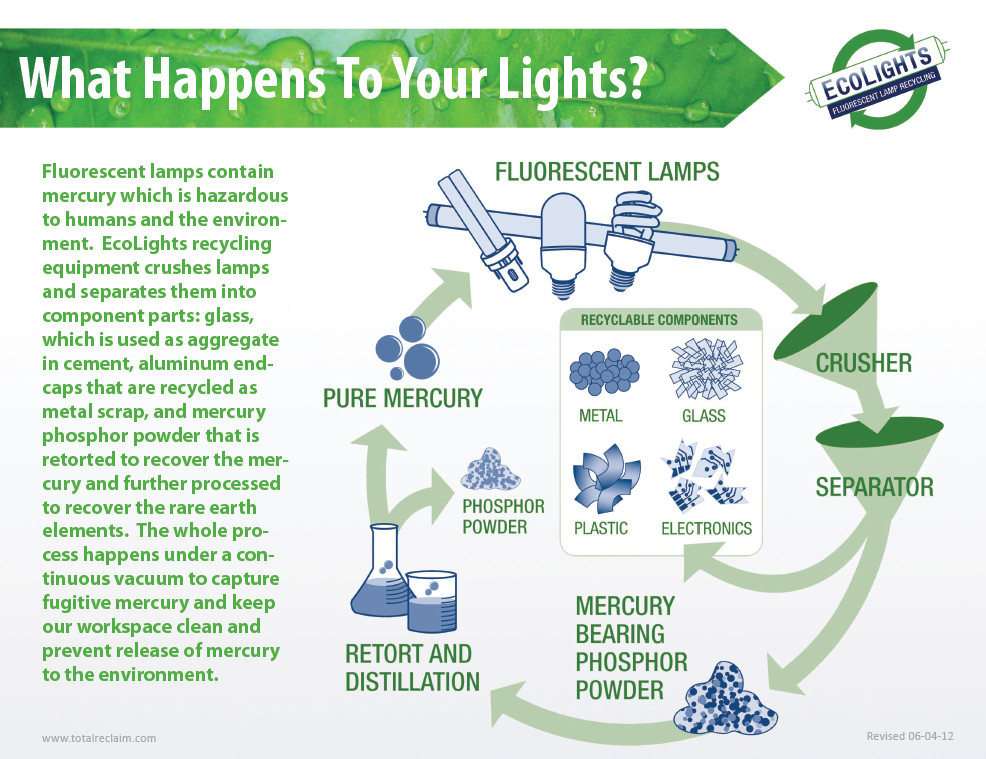
During recycling, lamps are crushed and the various materials are separated under a continuous vacuum filtration process. The glass, aluminum and mercury-bearing phosphor powder is captured safely and recycled for use in other products.
Virtually every component of a fluorescent lamp can be recycled, including metal end caps, lamp glass, and mercury phosphor powder. The recycled glass can be used as feedstock in the manufacture of glass products, or as cement aggregate. The aluminum end caps are recycled as metal scrap. Retorting recovers mercury from the mercury phosphor powder, which, after further purification, is reused in thermometers, barometers, and electronic devices.
Tremendous progress has been made with regard to public awareness about Fluorescent bulbs and mercury. Still, we must remain vigilant about the dangers of mercury as we enjoy the energy and cost savings of fluorescent bulbs.
Today, all fluorescent lamps can and should be recycled. Those who wish to dispose of their fluorescent lights in an environmentally responsible way have many lamp recycling options to choose from based on the volume of lamps and the frequency of their recycling needs.